
One standard, many calendars. EN 16931 is the same everywhere — but when a business must be able to receive, and when it must issue, each country decides for itself. This page collects the deadlines that actually matter to a business in the EU today.
Dates move. Poland has postponed its start several times; Spain waited years for an implementing order. What follows is accurate as of the date shown at the top of this page; before committing budget, check the source for the country in question.
Germany
| From | Who | What applies |
|---|---|---|
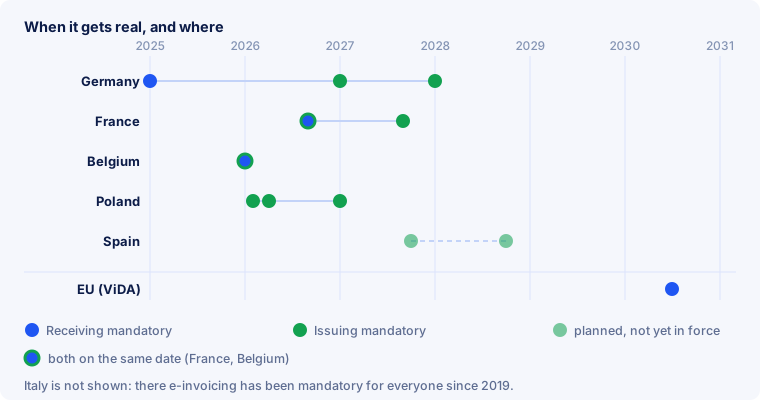
| 1 January 2025 | all domestic businesses | must be able to receive |
| 1 January 2027 | previous-year turnover above €800,000 | must issue |
| 1 January 2028 | all other domestic B2B turnover | must issue |
Exempt are small-amount invoices up to €250 gross, travel tickets, B2C sales and certain exempt supplies. Small enterprises under § 19 of the German VAT Act are permanently exempt from issuing — not from receiving.
Permitted formats follow EN 16931: ZUGFeRD from version 2.0.1 and XRechnung. The MINIMUM and BASIC WL profiles are excluded — they do not count as e-invoices for VAT, see Profiles. No transmission route is prescribed; an email inbox is enough as a receiving channel.
France
| From | Who | What applies |
|---|---|---|
| 1 September 2026 | all VAT-registered businesses | receiving |
| 1 September 2026 | large companies and mid-caps | issuing |
| 1 September 2027 | SMEs and micro-enterprises | issuing |
The big difference from Germany is not the date but the route: invoices must travel through an approved platform (formerly PDP, renamed plateforme agréée by the 2026 budget act). Alongside it sits e-reporting for transactions outside domestic B2B. Details in What is Factur-X.
Belgium
Since 1 January 2026, VAT-registered businesses in Belgium must issue and receive structured e-invoices for domestic B2B transactions — both on the same date, with no staging by size.
The intended route is the Peppol network (four-corner model) in EN 16931 formats, meaning UBL 2.1 or CII. Another route is permitted if both parties agree to it and the format follows the standard.
Out of scope are businesses invoicing only private customers, certain VAT-exempt activities and cross-border transactions — the domestic mandate does not reach them. A tolerance period ran to 31 March 2026; since then it has been enforced. E-reporting is announced for 2028.
Poland
| From | Who |
|---|---|
| 1 February 2026 | 2024 turnover above PLN 200 million |
| 1 April 2026 | all other taxpayers established in Poland |
| 1 January 2027 | micro-enterprises |
Poland takes a different route from Germany and Belgium: every invoice passes through the state platform KSeF (Krajowy System e-Faktur). That is not a transmission channel but a clearance point — an invoice does not legally exist until KSeF has accepted it and assigned a number. The format is a structured XML of its own, not ZUGFeRD.
The finance ministry has signalled a grace period on penalties through the end of 2027. A German supplier shipping to Poland is not caught by the Polish domestic mandate — it applies to taxpayers established there.
Spain
Spain runs two separate projects in parallel, and they are routinely confused:
- Verifactu concerns the invoicing software itself: it must keep records tamper-evident and report data to the tax authority. After the postponement by Real Decreto-ley 15/2025, it applies from 1 January 2027 to corporate income tax payers and from 1 July 2027 to the self-employed.
- B2B e-invoicing under the Crea y Crece act, implemented by Royal Decree 238/2026 of March 2026. The schedule foresees 1 October 2027 for companies above €8 million turnover and 1 October 2028 for everyone else.
The Spanish dates carry a caveat. They depend on the implementing order coming into force; until then they are announced dates rather than running deadlines. That is exactly why Spain appears faded in the chart above.
Italy
Italy is ahead of everyone: e-invoicing has been mandatory there since 1 January 2019 for all VAT-registered businesses, with no turnover threshold, and runs through the state platform SDI (Sistema di Interscambio).
The national format FatturaPA is an XML of its own — it expresses the same business content as EN 16931 but follows neither UBL nor CII. For day-to-day operation that is no problem; for the future it is. Italy operates under an EU derogation extended to the end of 2027 and will have to align its system with the EU model later.
A German business invoicing into Italy is not caught by the Italian domestic mandate — across borders the standard applies, not FatturaPA.
ViDA: the common frame
Above all the national calendars sits the EU package VAT in the Digital Age. The Council adopted it on 11 March 2025; it was published on 25 March 2025.
| Date | What happens |
|---|---|
| 14 April 2025 | Member States may mandate domestic e-invoicing without applying for a derogation |
| 1 July 2028 | single VAT registration, platform rules, extended reverse charge |
| 1 July 2030 | e-invoicing to EN 16931 becomes mandatory for intra-Community B2B, along with digital reporting |
| 1 January 2035 | national reporting systems must be aligned with the EU model |
The first row explains why the calendars are suddenly so crowded: until 2025 every country needed its own permission from Brussels for a domestic mandate. The third row is the reason for the EN 16931-1:2026 revision.
B2G has been running for years
Everything in the country calendars above concerns B2B. Invoices to public-sector buyers have had their own layer for longer: Directive 2014/55/EU obliged public authorities to accept e-invoices to EN 16931, and many countries extended the duty to suppliers.
In practice, for suppliers to the public sector:
- The format must follow the standard — usually XRechnung in Germany, Peppol BIS Billing 3.0 elsewhere.
- Hybrid files are generally accepted as long as the XML part is right — the clerk then gets a readable page as well.
- An extra identifier is almost always required: in Germany the routing ID in field
BT-10, elsewhere an order or contract number. Without it the invoice fails on a national rule rather than on the standard — see Business rules.
What this means in practice
Across all countries the same four questions come back. Answer them and you are ready for most calendars:
- Can you receive? That is the first deadline everywhere, and it hits everyone at once — including the business still writing invoices on paper.
- Does your system produce the EN 16931 profile? Not MINIMUM, not BASIC WL. That one document covers Germany, France and Belgium.
- Is the route settled? Germany: free, email is enough. France: an approved platform. Belgium: Peppol. Poland and Italy: a state platform with its own format.
- Is archiving sorted? Eight years in Germany, and what must be kept is the structured part — see PDF/A-3.
Frequently asked questions
I am in Germany and invoice into France — which calendar applies?
For your own obligations, the German one. The French mandate addresses businesses established there. In practice your French customer will expect a structured document sooner than the German deadline requires — and an invoice in the EN 16931 profile suits both sides.
Do I need a separate format per country?
Not for the countries built on EN 16931: the same file works in Germany, France and Belgium. Italy (FatturaPA) and Poland (KSeF XML) have formats of their own for domestic traffic — across borders the standard still applies.
What happens if I miss a deadline?
It depends on the country. Belgium introduced graduated penalties after a tolerance period to the end of March 2026; Poland has signalled a grace period through 2027. Either way: an invoice that does not meet the prescribed form is not a proper invoice for VAT — the exposure is the input tax deduction, not just a fine.
Does the mandate cover invoices to private customers?
No, B2C is out of scope in all the countries named. France does require the data to be reported for such transactions (e-reporting), and Spain addresses them through Verifactu.
Does ViDA change my national obligation?
Nothing before 2030. After that the intra-Community layer is added, and by 2035 national systems must be aligned. Working to EN 16931 today is the direction everything is heading in.
Where do I find the current state for a country not listed here?
The European Commission maintains country pages on e-invoicing, and national tax administrations publish their own timetables. Both are more reliable than any overview — including this one.
In short
- Receiving comes first and hits everyone at once; issuing is staged by size.
- Germany: receiving since 2025, issuing 2027 (above €800,000) and 2028.
- France: both from September 2026, SMEs issue from September 2027 — necessarily through an approved platform.
- Belgium: everything from January 2026, over Peppol.
- Poland: February and April 2026 through KSeF — the invoice comes into being when the system accepts it.
- Spain: announced for October 2027 and 2028, subject to the implementing order. Italy: since 2019 for everyone.
- ViDA: intra-Community from July 2030, national systems aligned by 2035.
Want one file that fits Germany, France and Belgium at once? Create a free account — or check an existing invoice without signing up and see whether it already meets the standard.