
Factur-X is a hybrid invoice: an ordinary PDF file, readable on screen like any other invoice, that also carries a structured XML dataset for automatic processing. One document, two readers — the human sees the page, the software reads the fields.
And it is, apart from the name, the same format as Germany’s ZUGFeRD. Not a related format, not a copy: the same schema, the same profiles, the same validation rules, version numbers published in parallel. Two names, two countries, one specification.
Who publishes it
Factur-X is maintained jointly by two bodies: FNFE-MPE (Forum National de la Facture Électronique et des Marchés Publics Électroniques) on the French side and FeRD (Forum elektronische Rechnung Deutschland) on the German side. Releases come out together and map one to one.
| Factur-X | ZUGFeRD | Published | In force from |
|---|---|---|---|
| 1.07.3 | 2.3.3 | 7 May 2025 | 15 May 2025 |
| 1.08 | 2.4 | December 2025 | — |
| 1.09 | 2.5 | 10 June 2026 | 1 July 2026 |
| 1.09.2 | 2.5.2 | 4 August 2026 | 1 September 2026 |
1.09.2 is a corrigendum: it clears up inconsistencies in validation rules, rounding and VAT breakdown, chiefly in the EXTENDED profile. An invoice produced in the EN 16931 profile is valid on both sides of the border — which is the entire point of building the two formats together.
The French mandate: the timeline
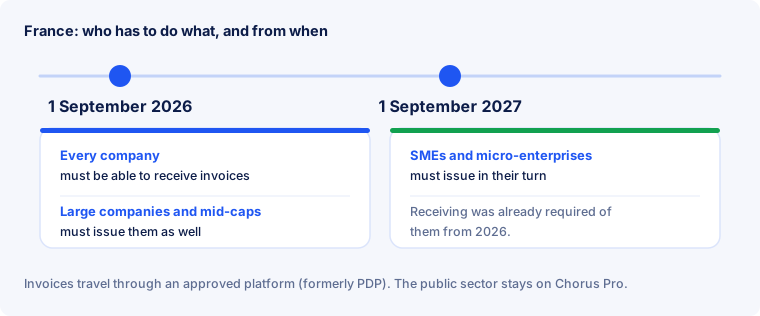
- 1 September 2026 — receiving. Every VAT-registered business established in France must be able to accept an e-invoice. No size threshold, no transition period.
- 1 September 2026 — issuing, for large companies and mid-caps (ETI).
- 1 September 2027 — issuing, for SMEs and micro-enterprises.
In practice, then, the date that matters to a small business is not 2027 but 2026: from then on its suppliers and its larger customers switch over, and it has to be able to receive what they send.
Where the invoices actually travel
Invoices no longer pass directly from one business to another: they go through an approved platform, a private operator registered with the tax administration. Every business needs one.
The terminology changed, and much of the published material has not caught up. What used to be called a “plateforme de dématérialisation partenaire” (PDP) is now a plateforme agréée (PA) — an approved platform: the replacement was written into the French tax code by article 123 of the 2026 budget act of 19 February 2026. The role and the obligations did not change. Where an article still says “PDP”, it means the same thing.
The Portail Public de Facturation (PPF) does not carry invoices itself. The original design had it also providing free exchange for simple cases; that function was dropped in October 2024. Two jobs remain:
- the central directory, which tells platforms where to deliver an invoice addressed to a given company;
- collecting the e-reporting data.
So the question is no longer “PPF or PDP” but “which approved platform”. Things worth comparing: the formats it accepts, how it connects to your accounting, what happens to an invoice that fails validation, and how long your archive stays reachable.
E-reporting: what gets declared besides the invoice
The reform has two halves, and the second one is easy to lose sight of. Alongside domestic B2B invoices, which actually travel, there are transactions outside that circuit whose data must be reported to the administration: sales to private individuals, exports, intra-Community supplies, transactions with non-taxable persons. For services, payment data comes on top.
What is transmitted is not the invoice but its tax summary: period, net amount, VAT per rate and, depending on the case, the number of transactions. It goes through the same approved platform, and the timetable is the one for issuing — 1 September 2026 for large companies and mid-caps, 1 September 2027 for SMEs and micro-enterprises.
The practical consequence: a retailer selling only to private customers may never issue a Factur-X, and is still covered by the reform.
Which formats are allowed, and why Factur-X
The minimum set every approved platform must accept is three structured formats: Factur-X, UBL 2.1 and CII. The latter two are plain XML files.
Hence the practical argument for Factur-X: it is the only one of the three that stays readable without tooling. Your customer sees an invoice rather than a file full of tags, your accountant can open it in any PDF reader, and your archive is still something a person can look at in five years. Nothing forces you to choose Factur-X — it is simply the least abrupt move for anyone who has been emailing PDFs.
One caveat: hybrid is not a half-measure. The embedded XML has to be complete and to agree with the visible page. A handsome page with a patchy XML is still a non-compliant invoice — see business rules.
Public sector: Chorus Pro stays
Invoicing French public-sector buyers has gone through Chorus Pro for years, long before the B2B reform, and the administration has confirmed the platform remains the public-sector reference beyond September 2026. Factur-X is one of the formats it accepts.
What changes on 1 September 2026 is that you get a choice: keep filing on Chorus Pro yourself, or let your approved platform deliver the invoice there, provided it is connected and offers that. Two pieces of advice that have not aged: use the EN 16931 profile unless the buyer says otherwise, and check that the recipient’s references are correct in the document — that is where most public-sector invoices go astray.
One invoice for France and Germany at once
If you bill customers in both countries you do not need two pipelines. An invoice produced in the EN 16931 profile is a valid Factur-X file and a valid ZUGFeRD file — the same document. What differs is national law, not the format:
- in France, the compulsory route through an approved platform, plus e-reporting;
- in Germany, direct delivery (an email inbox is enough), but the exclusion of the MINIMUM and BASIC WL profiles, which do not count as e-invoices there;
- country-specific mandatory particulars, which surface during validation as national rules.
Frequently asked questions
Are Factur-X and ZUGFeRD really the same format?
Yes, since Factur-X 1.0 / ZUGFeRD 2.1: the same CII schema, the same profiles, the same identifiers, releases published in parallel. The names differ because the organisations behind them differ.
Will an ordinary PDF still do after September 2026?
No. A PDF with no structured data is not an e-invoice under the reform, however good it looks. Turning existing invoices into real ones is covered in Convert a PDF invoice.
Do I have to pick an approved platform before September 2026?
For receiving, yes — reception runs through it. Choose on the formats it accepts, how it connects to your accounting and its archiving terms, not on price alone.
Which profile should I use?
EN 16931 as a rule. BASIC is enough for very simple invoices; EXTENDED only pays off if a recipient asks for a field the standard does not know. Details in Profiles.
What if my customer is German?
The same file works. On the German side receiving has been mandatory since 1 January 2025, and issuing follows in 2027 and 2028 depending on turnover.
How do I know my Factur-X file is sound?
By validating it. Three layers get checked: the PDF/A-3 container, the XML against its schema, then the business rules. You can check a file without signing up.
Is Chorus Pro going away?
No. It remains the public sector’s reference platform. The B2B reform is built alongside it, with the PPF and the approved platforms.
In short
- Factur-X is ZUGFeRD under another name — same schema, same profiles, parallel releases. The version in force is 1.09.2, since 1 September 2026.
- Receiving: everyone, from 1 September 2026. Issuing: large companies and mid-caps on the same date, SMEs and micro-enterprises a year later.
- Invoices travel through an approved platform (formerly PDP). The PPF keeps the directory and collects e-reporting; it no longer delivers.
- Three formats in the minimum set: Factur-X, UBL 2.1, CII. Only the first stays readable without tooling.
- Chorus Pro stays for the public sector, with the added option of going through your own platform.
Want conformant Factur-X invoices without writing the XML by hand? Create a free account — or start by checking an existing file without signing up.