
Peppol is not an invoice format. Peppol is a delivery network — and nearly every misunderstanding comes from two different things carrying the same name: the network a document travels on, and the message inside it.
The short version for Germany: you do not need Peppol to satisfy the German e-invoicing obligation. The transmission channel is free, and an ordinary email inbox is enough to receive. Peppol becomes interesting when you invoice abroad, supply public bodies, or have customers who require it.
Four corners, and what happens between them
The network runs on the four-corner model. You do not send to the recipient; you send to your own provider, whose counterpart on the other side delivers.
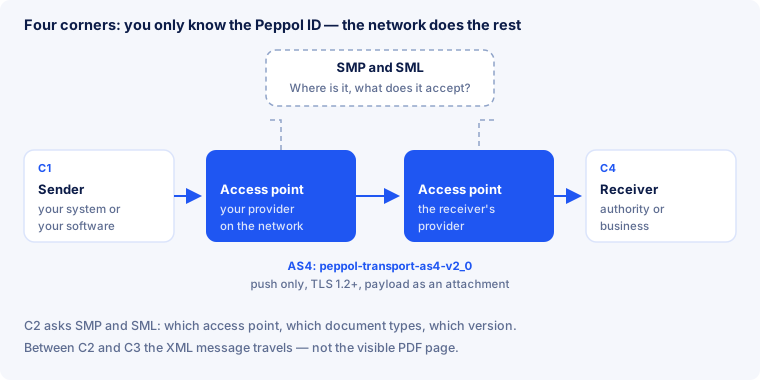
Before anything goes out, your access point queries two directories: SML and SMP. The first says where the details for that Peppol ID live; the second says which access point serves the recipient and which document types it accepts at all. That second answer is the important one — it explains how a technically flawless file can still be undeliverable.
Transport runs over AS4, in the Peppol flavour peppol-transport-as4-v2_0: push only and never pull, TLS 1.2 or newer, the payload as an attachment, and a mandatory envelope (SBDH) around every document. You see none of this as a user — but it is why a Peppol delivery has an acknowledgement at protocol level that email simply does not have.
The Peppol ID is the address
A Peppol ID is a scheme plus a value, written scheme:value. The common ones:
| Scheme | Value | Typical for |
|---|---|---|
0088 | GLN | retail and trade, widely used internationally |
9930 | VAT identifier, e.g. 9930:DE123456789 | German businesses |
0204 | Leitweg-ID | German public authorities |
For public bodies, two things that are normally separate coincide: the Leitweg-ID sits inside the invoice as the buyer reference (BT-10) and, with the prefix 0204, doubles as the network address. A wrong Leitweg-ID therefore breaks two things at once.
Do not confuse it with the electronic address inside the invoice itself (BT-34 for the seller, BT-49 for the buyer). That field carries its own scheme — in files produced by this service it holds the email address (EM), not a Peppol ID.
Peppol BIS Billing 3.0 — the message, not the network
Peppol BIS Billing 3.0 is the invoice specification that travels on the network: a core invoice usage specification (CIUS) of EN 16931 in UBL 2.1 syntax. It is not validated against a schema of its own but with Schematron rules layered on top of the UBL schema — which is where the PEPPOL-EN16931-* codes come from, alongside the familiar BR-* ones.
The specification is refreshed twice a year, and that is not a formality: version 3.0.21 was published on 20 May 2026 and has been binding since 17 August 2026. Choosing a provider also means choosing whether someone there tracks such dates.
The part that concerns ZUGFeRD users: receivers on the network must be able to accept UBL. The CII syntax — precisely the one inside a ZUGFeRD or Factur-X file — is only optional in the BIS: it arrives only where the receiver has explicitly registered it in the SMP. In practice the access point converts. And the visible PDF page does not travel with it. What goes over Peppol is the structured message, not the hybrid document.
Alongside BIS Billing, PINT now travels too — the international invoicing model with country specialisations (EU, Japan, Singapore, Australia/New Zealand, Malaysia). Version 1.1.3 was published on 8 June 2026 and has been binding for service providers since 7 September 2026. Both are UBL; the difference is which rule set checks the file when it lands. A merger of the two lines has been announced — there is no date for it, and anyone quoting you one made it up.
Where Peppol is mandatory — and where it is not
| Country | Role of Peppol |
|---|---|
| Germany, B2B | no prescribed channel; email is enough, Peppol is one option |
| Germany, B2G | the usual route into the invoice portals, addressed by Leitweg-ID |
| Belgium | since 1 January 2026 the intended channel for domestic B2B |
| Slovakia | from 1 January 2027 B2B over Peppol, with a fifth corner |
That the channel is free in Germany is exactly what the Ministry of Finance letters say: email, download from a portal, EDI or an interface — what the parties agree on is a matter of civil law between them. A separate inbox just for e-invoices is not required.
The fifth corner is why Peppol keeps reappearing in legislation. Slovakia adopted its B2B obligation for 1 January 2027 (Act 385/2025 Z. z., passed by parliament on 9 December 2025 and published on 19 December 2025): invoices travel the ordinary four-corner network while the data additionally reaches the tax administration — the fifth corner. Country deadlines are collected under transition deadlines.
Choosing an access point
An access point is an accredited service provider; nobody connects to the network directly. What matters when choosing:
- Which document types it offers — Billing 3.0 in the current version, and whether PINT too, if you invoice outside Europe.
- Whether it keeps up with releases. The 17 August 2026 deadline is the pattern: a provider who sleeps through those dates becomes your problem, not theirs.
- Whether it converts your CII into UBL if your system produces ZUGFeRD or Factur-X — otherwise that conversion is yours to build.
- Receiving, not just sending. Your Peppol ID is registered in their SMP, and incoming post arrives through them from then on.
- How a switch works. That registration is exactly where changing provider gets sticky. Ask before signing, not after.
- The pricing model — per document or flat — and what inbound costs, not only outbound.
What Peppol is not
- Not a format. Your invoice is built to EN 16931; Peppol only settles the syntax it goes out in.
- Not an archive. The retention obligation stays with you, including everything under retention. An access point is not a filing place.
- Not a confirmation that the invoice is right. What is checked are the BIS rules — not whether the VAT category, the description of what you supplied and the amounts match your actual business. What validation does and does not prove is covered under validation.
- Not a precondition for the German obligation. See above.
What E-Rechnung Pro can do here — and what it cannot
Not an access point. The service sends nothing into the Peppol network and has no connection to it. It builds and checks files; sending is yours or your provider's job.
Two things are worth mentioning anyway, because they really are in the generated file:
- As the business process (BT-23), every invoice built here carries
urn:fdc:peppol.eu:2017:poacc:billing:01:1.0— the usual identifier of the standard billing process. That does not make the file a Peppol message; it is the value the validation rules expect in that field. - The electronic address (BT-34/BT-49) is filled from the email address, scheme
EM. If you want a Peppol ID there, it gets substituted in the target system.
What the service is good for here: checking the file before it goes to an access point. Having it clear EN 16931 and the German rules saves the round trip where your provider rejects the same file.
Frequently asked questions
Do I need Peppol for the German e-invoicing obligation?
No. The transmission channel is not prescribed; an email inbox is enough for receiving, and a dedicated inbox for it is not required.
Can I send a ZUGFeRD file over Peppol?
The XML inside it is CII, and CII is optional on the network — only receivers that registered it in the SMP get it. The usual path is conversion to UBL by the access point. The visible PDF page never travels along.
What is my Peppol ID?
A scheme plus a value, for example 9930:DE123456789 with a VAT identifier, or 0088 with a GLN. German authorities are addressed by 0204 plus the Leitweg-ID. It is issued and registered through your access point.
What does Peppol cost?
The network itself sells nothing — you pay the service provider. Models are typically per document or a flat fee; compare both directions, sending and receiving.
Is Peppol the same as Peppol BIS Billing 3.0?
No. Peppol is the network, BIS Billing 3.0 is the invoice specification carried on it. Other documents, such as orders, travel the same network.
Who checks the invoice on the way?
The access point checks it against the BIS rules and rejects what breaks them. Whether the content is right — VAT category, amounts, what you actually supplied — nobody checks for you.
What is the five-corner model?
The four familiar corners plus the tax administration as a fifth, receiving the invoice data. Slovakia introduces it on 1 January 2027, which turns a delivery network into a reporting channel as well.
In short
- Peppol is the network, BIS Billing 3.0 the message — two things, one name.
- Four corners: you know only the Peppol ID; SMP and SML settle the rest.
- UBL is mandatory, CII optional — the CII out of ZUGFeRD arrives only where the receiver registered it.
- The current version is 3.0.21, binding since 17 August 2026; your provider has to keep up with such dates.
- Germany leaves the channel free, Belgium makes Peppol the channel, Slovakia adds a fifth corner from 2027.
- Check before the access point does and you save the rejection round.
Before the file goes to an access point: upload it here — checked against EN 16931 and the German rules, without signing up.